Punjab Smart Syllabus 2027 for Class 9 and 11: Deleted Topics by Subject
Punjab smart syllabus 2027 for Class 9 and 11: deleted chapters and topics with textbook pages, pairing scheme marks and how to check the official PECTAA PDF.
یہ صفحہ اردو میں پڑھیں
The Punjab smart syllabus 2027 is out for Class 9 and Class 11 only. PECTAA notified both lists on 6 November 2026, for all nine Punjab boards and the Annual Exam 2027. Each list names the deleted topics, the pairing scheme and a model paper. Download them from pectaa.edu.pk, under Curriculum and Compliance. Class 10 and 12 lists were not there when we checked on 7 November.
| Class | Notification | What it covers |
|---|---|---|
| Class 9 (Grade 9) | No. PECTAA/C&C Unit/2026/1238, dated 06.11.2026 | Physics, Chemistry, Mathematics, Biology, Urdu, English, Islamiat |
| Class 11 (Grade 11) | No. PECTAA/C&C Unit/2026/1239, dated 06.11.2026 | English, Urdu, Mathematics, Physics, Computer Science and Entrepreneurship, Biology, Chemistry |
| Class 10 and Class 12 | Not on PECTAA's page yet | Keep studying the full book for now |
A smart syllabus is a shorter exam syllabus. PECTAA calls it the Accelerated Learning Programme, or ALP. The textbook stays the same, but some topics and exercise questions are taken out of the board exam. Paper setters are told not to ask anything from them.
We read both notifications and every annex page in full. The Class 9 annex is a scanned document, so we read it page by page. Below is what each subject drops, with the textbook page numbers, and how each paper is marked.
PECTAA notified the smart syllabus for Class 9 and Class 11 on 6 November 2026
PECTAA notified the Class 9 and Class 11 smart syllabus on 6 November 2026, after its Academics Committee approved it on 5 November. It applies to the 2026-27 session and the BISE Annual Examination 2027, across Punjab.
PECTAA is the Punjab Education, Curriculum, Training and Assessment Authority. It replaced the old Punjab Curriculum and Textbook Board. Both notifications are issued under Section 9(1)(b) of the PECTAA Act 2025, and both were approved at the Academics Committee's 13th meeting.
The copy list on each notification names all nine boards: Lahore, Gujranwala, Rawalpindi, Sargodha, Faisalabad, Sahiwal, Multan, Dera Ghazi Khan and Bahawalpur. So the same deleted topics apply to every board. A board cannot set its own shorter list. The Punjab Boards Committee of Chairpersons, the body behind rules such as six exam attempts in four years, is copied on both notifications too.
One rule sits at the top of every subject. Questions of all types come from the whole textbook, except the topics and questions that are listed as deleted. So anything not on the list is still in your exam.
Class 9 smart syllabus 2027 deleted topics, subject by subject
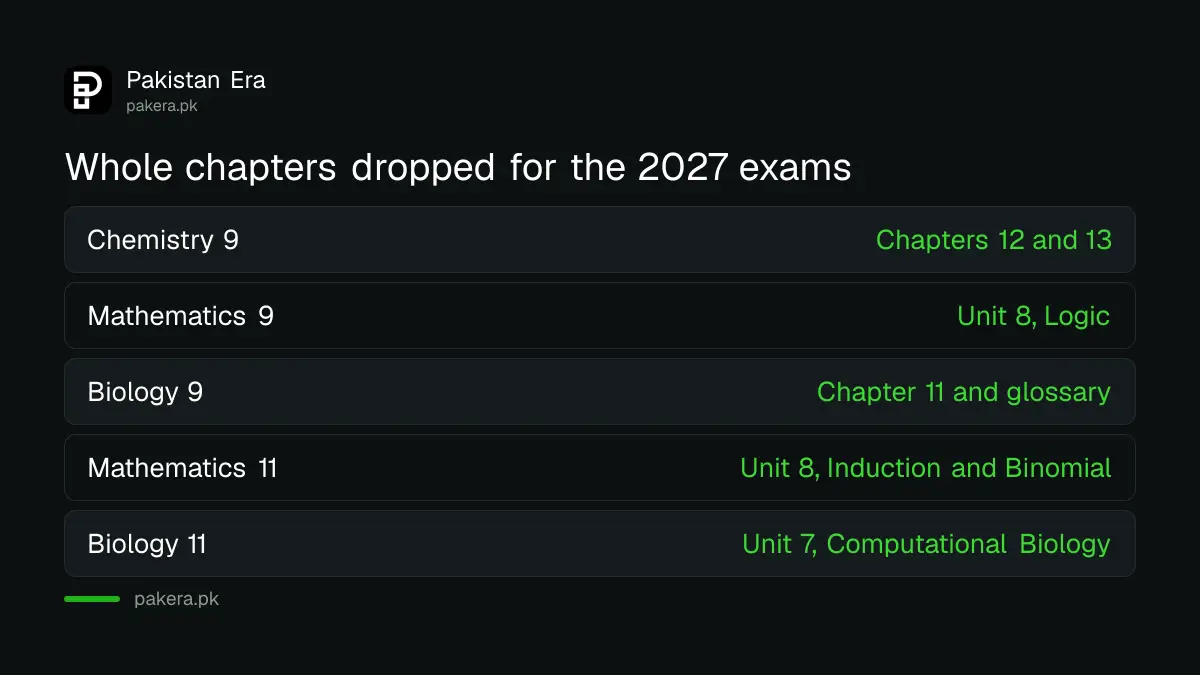
The Class 9 annex covers seven subjects: Physics, Chemistry, Mathematics, Biology, Urdu, English and Islamiat. Four subjects lose whole chapters: Chemistry, Mathematics, Biology and Islamiat. Every other change is a list of topics and exercise questions inside chapters that stay.
Physics 9
All nine chapters stay, but each loses some topics. The exercise questions marked in the annex are also out.
| Chapter | Deleted topics | Textbook pages |
|---|---|---|
| 1 Physical Quantities and Measurements | 1.6 Mass measuring instruments, 1.7 Time measuring instruments, 1.8 Errors in measurements, 1.10 Uncertainty, 1.12 Precision and accuracy | 16 to 22 |
| 2 Kinematics | 2.3 Types of motion, 2.8 Gradient of a distance time graph, 2.10 Gradient of a speed time graph | 33, 41, 43 |
| 3 Dynamics | 3.2 Fundamental forces, 3.3 Forces in a free body diagram, 3.5 Limitation of Newton's laws, 3.7 Mechanical and electronic balances | 55 to 57, 61, 64 to 65 |
| 4 Turning Effects of Force | 4.7 Centre of gravity and centre of mass, 4.11 Improvement of stability, 4.12 Application of stability, rotational versus translational motion | 88 to 90, 95 to 97 |
| 5 Work, Energy and Power | 5.4 Sources of energy, 5.6 Advantages and disadvantages of energy production methods | 113 to 118 |
| 6 Mechanical Properties of Matter | Applications of Hooke's law, 6.7 Measurement of atmospheric pressure, 6.8 Pressure by manometer, Activities 6.1 and 6.6 | 129, 130, 137 to 138, 142 |
| 7 Thermal Properties of Matter | 7.1 Kinetic molecular theory, 7.4 Sensitivity, range and linearity of thermometers, 7.5 Liquid in glass thermometer | 149 to 150, 155 to 156 |
| 8 Magnetism | Applications of permanent magnets, magnetic relay, telephone receiver, 8.8 Domain theory, 8.10 Magnets in recording technology, 8.11 Soft iron as magnetic shield | 168 to 177 |
| 9 Nature of Science | 9.4 Interdisciplinary research, 9.6 Scientific base of technology and engineering | 186 to 187, 190 to 191 |
Chemistry 9
Chapters 12 and 13 go completely. Chapter 4, Stoichiometry, keeps all its topics and loses only exercise questions.
| Chapter | Deleted topics | Textbook pages |
|---|---|---|
| 1 States of Matter and Phase of Change | 1.2 States of matter, 1.4 Allotropic forms, 1.8 Effect of temperature on solubility | 4 to 13 |
| 2 Atomic Structure | 2.3 Isotopes and their masses, radioactive isotopes and their uses | 24 to 26 |
| 3 Chemical Bonding | 3.6 Ionic and covalent compounds compared, 3.8 Nature of bonding and properties | 44, 46 to 48 |
| 5 Energetics | Part of 5.3 Exothermic and endothermic reactions, from the last paragraph | 71 to 74 |
| 6 Equilibria | 6.3 Changing the physical conditions of a reaction | 86 to 89 |
| 7 Acid Base Chemistry | 7.5 Acid rain and its effects | 102 |
| 8 Periodic Table and Periodicity | 8.5 Metallic character and reactivity | 114 to 115 |
| 9 Group Properties and Elements | 9.5 Physical properties of metals and non-metals | 124 to 125 |
| 10 Environmental Chemistry | 10.4 Global warming, 10.5 Strategies to reduce environmental issues | 136 to 141 |
| 11 Hydrocarbons | 11.4 Important reactions | 151 to 153 |
| 12 Empirical Data Collection and Analysis | Full chapter deleted | Whole chapter |
| 13 Laboratory and Practical Skills | Full chapter deleted | Whole chapter |
Mathematics 9
Unit 8, Logic, is excluded completely. Most other units lose their real life application sections and one or two exercises. The marked review exercise questions are also out.
| Unit | Main exclusions | Textbook pages |
|---|---|---|
| 1 Real Numbers | 1.1 Introduction, 1.3 Applications in daily life (temperature, profit and loss), Exercise 1.3 | 1 to 3, 14 to 19 |
| 2 Logarithms | 2.4 Laws of logarithm Examples 12 to 15, Exercise 2.4 | 30 to 35 |
| 3 Sets and Functions | 3.3 Binary relations, functions, domain and range, linear and quadratic functions, Exercise 3.3 | 37 to 39, 55 to 61 |
| 4 Factorization | 4.4 Square root of an algebraic expression, 4.4.1 Real world problems, Exercise 4.4 | 77 to 80 |
| 5 Linear Equations and Inequalities | 5.3 Feasible solution, maximum and minimum values, Exercise 5.2 | 91 to 95 |
| 6 Trigonometry | 6.6 Angle of elevation and depression, Exercise 6.6 | 118 to 120 |
| 7 Coordinate Geometry | 7.3 Applications in real life, Exercise 7.3 | 141 to 145 |
| 8 Logic | Complete chapter excluded | Whole chapter |
| 9 Similar Figures | 9.4 Geometrical properties of polygons and their applications, Exercise 9.4 | 177 to 182 |
| 10 Graphs of Functions | 10.2 Exponential growth and decay, gradients of curves, graphs in real life, Exercise 10.2 | 193 to 197 |
| 11 Loci and Construction | 11.5.2 Intersection of loci, 11.6 Real life application, Exercise 11.2 | 209 to 213 |
| 12 Information Handling | 12.2.4 Weighted mean | 234 to 235 |
| 13 Probability | 13.6 Expected frequency, 13.7 Real life application | 255 to 256 |
Biology 9
Chapter 11, Biostatistics, is deleted in full, and so is the glossary. In every chapter the Key Points and all Inquisitive questions are out, along with named MCQs, short and long questions.
| Chapter | Deleted topics | Textbook pages |
|---|---|---|
| 1 The Science of Biology | 1.2 Biology and other sciences, 1.3 Careers in biology, 1.5 Science as a collaborative field, 1.8 Malaria as an example of the biological method | 8 to 14, 17 to 20 |
| 2 Biodiversity | Advantages of classification, history of classification, tables and box | 27 to 36 |
| 3 The Cell | 3.3 Structural advantages of plant and animal cells, division of labour within and across cells | 52 to 57 |
| 4 Cell Cycle | 4.4 Comparison between meiosis and mitosis | 73 to 75 |
| 5 Tissues, Organs and Organ System | Emergent properties, role of organ systems in homeostasis | 81 to 82, 89 |
| 8 Bioenergetics | Use of respiratory energy in the body, tables, Figure 8.8 | 128 to 129 |
| 9 Plant Physiology | Roles of nitrogen and magnesium | 135 |
| 11 Biostatistics | Entire chapter deleted | 167 to 175 |
| Glossary | Completely deleted | 176 to 180 |
Chapters 6, 7 and 10 keep all their topics. They lose only the Key Points and the listed exercise questions.
English, Urdu and Islamiat 9
- English 9: three of the 11 units are out. Unit 5, Women Empowerment through Entrepreneurship (pages 58 to 71). Unit 8, The Impact of Globalisation on Culture and Economy (pages 93 to 105). Unit 10, The Silent Predator and the Majestic Prey: Snow Leopard and Markhor (pages 120 to 131).
- Urdu 9: four of the 19 lessons are out, so students prepare 15. Two prose lessons, Ibtidai Hisab by Ibn-e-Insha (pages 69 to 76) and Bheriya by Farooq Sarwar (pages 86 to 93). The poem Cricket aur Mushaira by Dilawar Figar (pages 111 to 117). And the ghazal by Khwaja Haider Ali Atish (pages 122 to 126). The pairing scheme also says no question will be asked on the introductions of writers and poets.
- Islamiat (Compulsory) 9: Ahadith No. 3, 6, 7, 12 and 14 from Chapter 1. In Chapter 4, the lessons on Ikhlas and Taqwa, Parda Poshi, lying, backbiting and slander, magic, and omens and superstition. In Chapter 5, oaths and the Islamic state. Twelve named personalities in Chapter 6. Chapter 7 is listed as complete, with its four lessons.
The Class 9 annex has no pages for Computer Science, Tarjuma-tul-Quran or any other subject. If your subject is not in the seven above, nothing has been notified for it yet. Keep studying the full book.
Class 9 pairing scheme 2027 sets 60, 75 and 100 mark papers
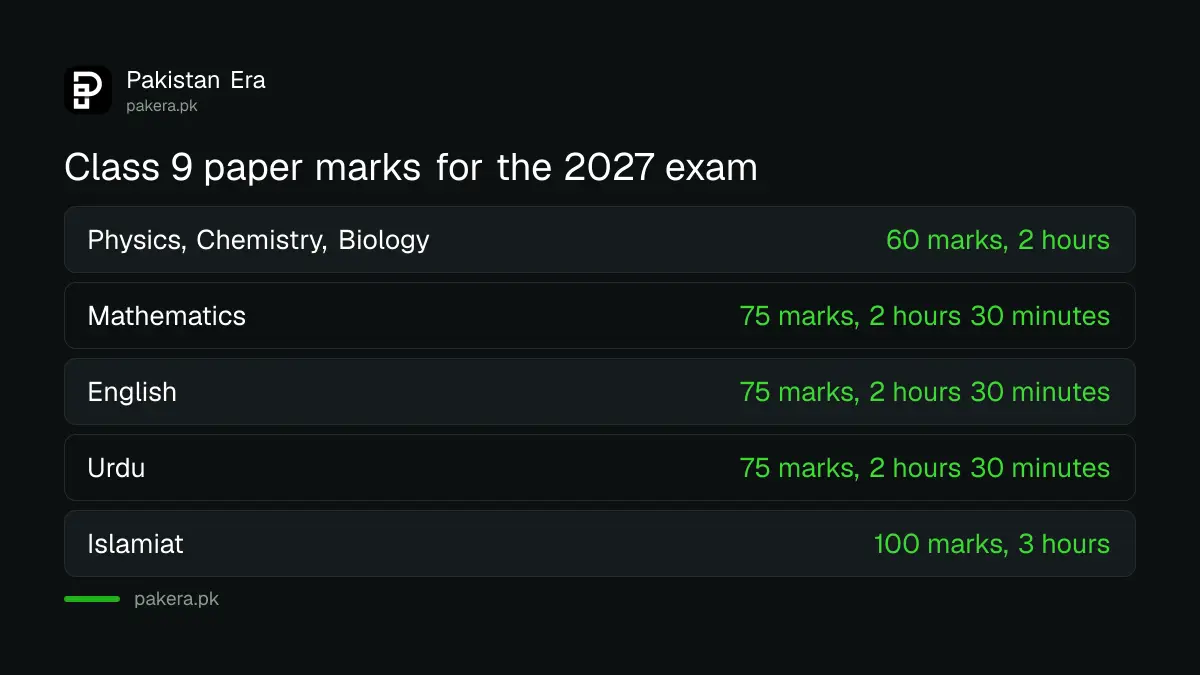
The Class 9 science papers are 60 marks each and take 2 hours. Mathematics, English and Urdu are 75 marks in 2 hours 30 minutes. Islamiat is 100 marks in 3 hours. Every paper starts with an objective part of MCQs.
| Subject | Total marks | Objective part | Subjective part | Total time |
|---|---|---|---|---|
| Physics 9 | 60 | 12 marks, 15 minutes | 48 marks, 1 hour 45 minutes | 2 hours |
| Chemistry 9 | 60 | 12 marks, 15 minutes | 48 marks, 1 hour 45 minutes | 2 hours |
| Biology 9 | 60 | 12 marks, 15 minutes | 48 marks, 1 hour 45 minutes | 2 hours |
| Mathematics 9 | 75 | 15 marks, 20 minutes | 60 marks, 2 hours 10 minutes | 2 hours 30 minutes |
| English 9 | 75 | 19 marks, 20 minutes | 56 marks, 2 hours 10 minutes | 2 hours 30 minutes |
| Urdu 9 | 75 | 15 marks, 20 minutes | 60 marks, 2 hours 10 minutes | 2 hours 30 minutes |
| Islamiat 9 | 100 | 20 marks of MCQs | 40 marks of short questions, 20 marks of Hadith translation and notes on personalities, 20 marks of long answers | 3 hours |
In the three science papers you answer 5 of 8 short questions in each of three blocks, then 2 of 3 long questions. Each long question has a 4 mark part and a 5 mark part, from different chapters. Mathematics asks 6 of 9 short questions in each of three blocks, then 2 of 3 long questions and 1 of 2 in the last part.
The pairing scheme tells you which chapters feed each question. Physics, for example, takes two MCQs each from Chapters 3, 4 and 6, and one from each of the other chapters. Read your own subject's scheme in the PDF before you plan revision, because it shows where the marks sit.
Class 11 smart syllabus 2027 deleted topics, subject by subject
The Class 11 annex covers English, Urdu, Mathematics, Physics, Computer Science and Entrepreneurship, Biology and Chemistry. Mathematics, Biology and Chemistry lose whole chapters. English loses four full units.
English 11
Four of the 14 units are excluded, and students focus on the other ten.
- Unit 4, Team Moon, pages 42 to 55
- Unit 7, What You Do is What You Are, pages 82 to 94
- Unit 9, Freedom (poem), pages 105 to 113
- Unit 12, The Impact of AI on Society, Human Relationships, and Ethics, pages 131 to 138
Mathematics 11
Unit 8, Mathematical Induction and Binomial Theorem, is deleted completely. Units 5, Partial Fractions, and 9, Division of Polynomials, are kept in full.
| Unit | Main exclusions | Textbook pages |
|---|---|---|
| 1 Complex Numbers | 1.4.1 Polar form, 1.5 Complex numbers in the real world, Exercise 1.5 Q 2 to 22 | 15 to 21 |
| 2 Functions and Graphs | 2.5 Real life applications, Exercise 2.2 Q 4 and 5 | 31 to 33 |
| 3 Quadratic Functions | 3.5 Real world problems, Exercise 3.2 Q 2 to 7 | 41 to 43 |
| 4 Matrices and Determinants | 4.6 Row operations, 4.7 Echelon forms, 4.8 and 4.9 Systems of linear equations, 4.10 Applications | 61 to 77 |
| 6 Sequences and Series | 6.8 Arithmetico-geometric progression, 6.11 Real life problems, Exercises 6.8 and 6.11 | 106 to 110, 117 to 122 |
| 7 Permutations and Combinations | Selected questions from Exercises 7.2, 7.3 and 7.4 | 129 to 139 |
| 8 Mathematical Induction and Binomial Theorem | Complete unit deleted | Whole unit |
| 10 Trigonometric Identities | 10.6 Triple angle identities, parts of Exercises 10.3 and 10.4 | 192 to 199 |
| 11 Trigonometric Functions and Graphs | 11.4 Graphs of sin, cos and tan, Exercise 11.2 | 205 to 211 |
| 12 Limit and Continuity | 12.4 Real world problems, Exercise 12.3 | 234 to 236 |
| 13 Differentiation | 13.7 Applications of differentiation, Exercise 13.3 | 255 to 257 |
| 14 Vectors in Space | 14.4 Scalar triple product, Exercise 14.4 | 283 to 290 |
Physics 11
All 12 chapters stay. Each one loses named topics, worked examples and exercise questions.
| Chapter | Main deleted topics |
|---|---|
| 1 Measurements | 1.1 Physical quantities and units, 1.2 International system of units |
| 2 Force and Motion | 2.1 Scalars, 2.2 Vectors, graphical derivation of the equations of motion, 2.10 and 2.11 collisions in two dimensions, 2.12 Rocket propulsion |
| 3 Circular and Rotational Motion | Applications of centripetal force, flywheel, gyroscope |
| 4 Work, Energy and Power | 4.1 Work done by a constant force, 4.5 Energy (K.E.) |
| 5 Solids and Fluid Dynamics | 5.1 Classification of solids, 5.4 Young's modulus of a wire, 5.10 Increase in flow velocity, 5.15 Viscous fluids, 5.16 Superfluids |
| 6 Heat and Thermodynamics | 6.1 Assumptions of the kinetic theory of gases, 6.6 Heat engine |
| 7 Waves and Vibrations | 7.1 Waves, 7.4 Stationary waves, tuning musical instruments |
| 8 Physical Optics and Gravitational Waves | 8.2 Types of polarization, optical activity, space-time distortion and tidal forces |
| 9 Electrostatics and Current Electricity | Electric field lines, applications of Gauss's law, 9.7 to 9.9 charged particles and shielding, 9.19 Galvanometer |
| 10 Electromagnetism | 10.3 Magnetic flux linkage, 10.5 Velocity selector, 10.7 Lenz's law |
| 11 Special Theory of Relativity | 11.5 Space-time in relativity |
| 12 Nuclear and Particle Physics | 12.8 Conservation laws, 12.10 Plasma, 12.11 Forces between particles, 12.12 The standard model |
Chemistry, Biology and Computer Science 11
- Chemistry 11: Chapter 15, Basic Separation Techniques, and Chapter 16, Lab Safety and Practical Skills, are deleted in full. Large parts of Chapter 3, Chemical Bonding (3.1 to 3.5, pages 44 to 51), and Chapter 14, Atmosphere (14.8 to 14.16, pages 306 to 311), are also out. Every other chapter loses some named topics. Electrochemistry, for example, loses nine topics, including 10.18 Nernst Equation and 10.22 Winkler Method (pages 216 to 232).
- Biology 11: Unit 7, Structural and Computational Biology, is deleted with all its questions (pages 167 to 176). The rest lose named topics, such as 1.5 to 1.8 in Biodiversity and Classification and 11.4 Cardiovascular Disorders, plus all Inquisitive questions.
- Computer Science and Entrepreneurship 11: no full unit goes. The cuts include 2.8 to 2.10 on object-oriented Python, testing and debugging (pages 35 to 38), 3.3.3 Complexity classes, 5.3 Building statistical models (pages 74 to 79), 6.4 and 6.5 on blockchain (pages 92 to 97), 7.3 The digital divide and 9.5 Financial concepts for business. Units 4 and 8 are kept in full.
The Class 11 PDF also has the Urdu syllabus and its pairing scheme, and other pages in Urdu. Those pages did not come out as readable text when we opened the file, so we have not listed their deleted lessons here. Open the PDF for Urdu 11 rather than trusting a typed copy.
Class 11 pairing scheme 2027 keeps 100 and 85 mark papers
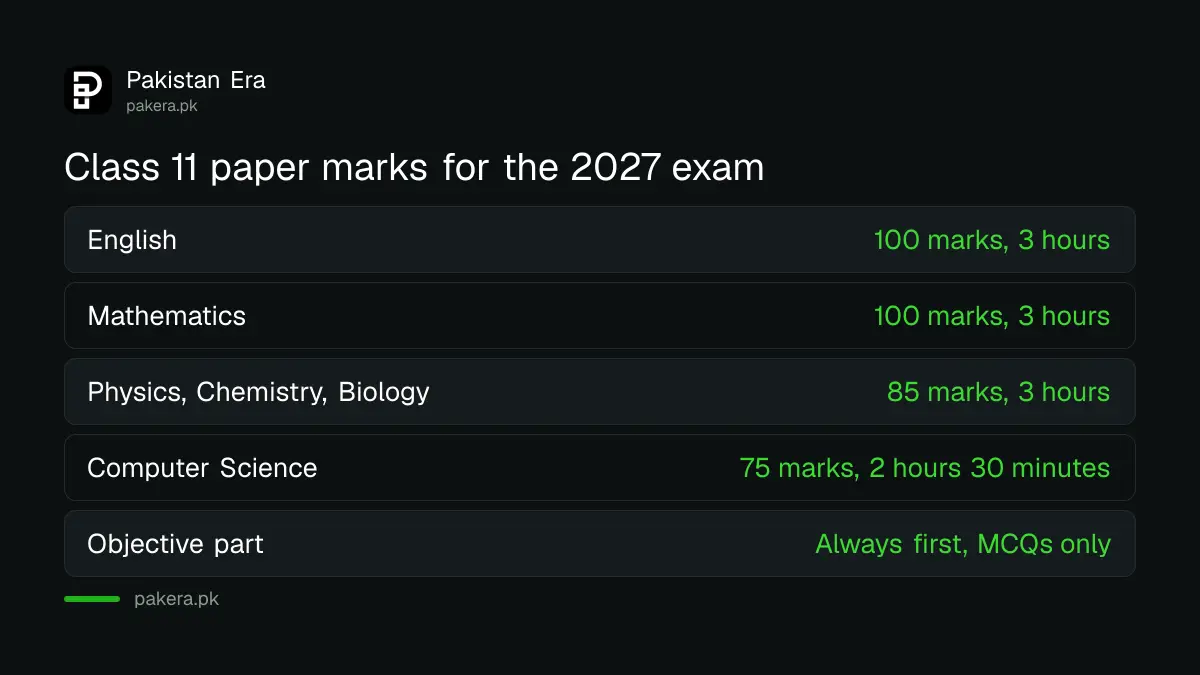
English and Mathematics for Class 11 are 100 mark papers. Physics, Chemistry and Biology are 85 marks each, in 3 hours. Computer Science and Entrepreneurship is 75 marks in 2 hours 30 minutes.
| Subject | Total marks | Objective part | Subjective part | Total time |
|---|---|---|---|---|
| English 11 | 100 | 20 marks, 30 minutes | 80 marks, 2 hours 30 minutes | 3 hours |
| Mathematics 11 | 100 | 20 marks, 30 minutes | 80 marks, 2 hours 30 minutes | 3 hours |
| Physics 11 | 85 | 17 marks, 20 minutes | 68 marks, 2 hours 40 minutes | 3 hours |
| Chemistry 11 | 85 | 17 marks, 20 minutes | 68 marks, 2 hours 40 minutes | 3 hours |
| Biology 11 | 85 | 17 marks, 20 minutes | 68 marks, 2 hours 40 minutes | 3 hours |
| Computer Science and Entrepreneurship 11 | 75 | 15 marks, 20 minutes | 60 marks, 2 hours 10 minutes | 2 hours 30 minutes |
In the 85 mark science papers you answer 8 of 12 short questions twice, then 6 of 9, then 3 of 5 long questions worth 8 marks each. Mathematics asks 3 of 5 long questions worth 10 marks each. The chapter split for each question is printed in the PDF.
Check that your smart syllabus copy is the official PECTAA version
Use only the PDF on pectaa.edu.pk, and match its notification number and date. Class 9 is No. 1238 and Class 11 is No. 1239, both dated 06.11.2026. Every annex page carries a large PECTAA watermark.
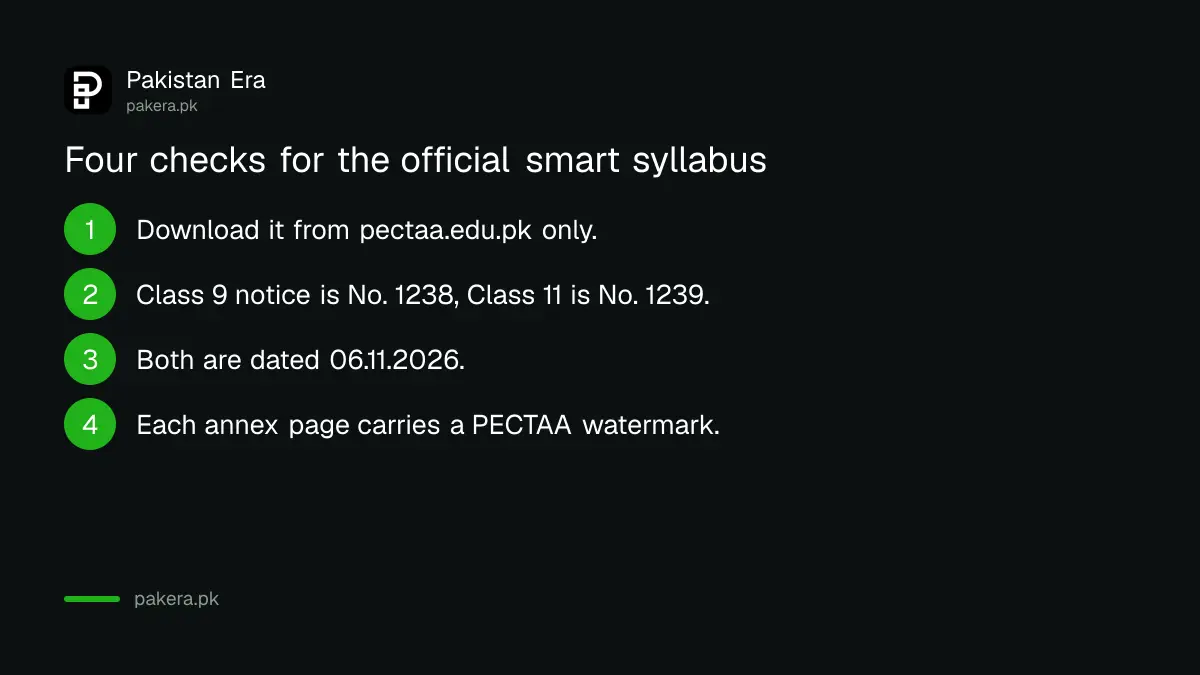
- Open pectaa.edu.pk and go to Curriculum and Compliance, then the Smart Syllabus section.
- Download "Smart Syllabus (Accelerated Learning Programme-ALP) Grade-9" or "Grade-11".
- Check page 1: the number PECTAA/C&C Unit/2026/1238 for Class 9 or 1239 for Class 11, and the date 06.11.2026.
- Check that the annex for your subject is there and marked Annex-A, with the PECTAA watermark.
- If a WhatsApp list or a shop printout says something different, follow the PDF.
Some lines in the annex are printed in red and marked "Revised". Those are the changed parts, so read them twice. And be wary of any list for Class 10 or 12 that claims to be official this week. PECTAA had not posted one when we checked.
When the site is busy it can show a database error. We saw one on the afternoon of 7 November. Wait a few minutes and try again, rather than downloading a copy from somewhere else. The same habit of going straight to the official site works for Punjab board result sites, where copycat pages are common.
Class 10 and Class 12 smart syllabus 2027 is not notified yet
PECTAA's page showed only Class 9 and Class 11 on 7 November 2026. Until Class 10 and 12 lists appear there, students in those classes should study the full textbook and follow their teachers. Do not drop a chapter on a guess.
Class 10 students also sit their exam on the Class 10 book, not the Class 9 one. So the Class 9 list does not tell you what Class 10 loses. The same is true for Class 12 and the Class 11 list. One separate list does exist: BISE Lahore published a Class 10 syllabus for hearing impaired students in October, but it covers that group only.
When PECTAA posts the Class 10 and Class 12 notifications, we will add their tables to this page with the notification numbers. Until then, the safest plan is the full book.
The new Class 9 books in Punjab follow the reformed curriculum, which is why the chapter names may look unfamiliar. The background is in our report on Punjab's new school curriculum with fewer books. Khyber Pakhtunkhwa is moving its own Class 9 to 12 curriculum from 2027, but KP's boards do not follow PECTAA's list.
Class 9 students also have board paperwork due this month. Gujranwala, for example, set a 30 November 2026 biometric deadline for Class 9, and Class 11 has its own biometric date for older matric students.
Common questions
Is the Punjab smart syllabus 2027 the same for all boards?
Yes. PECTAA notified it for implementation across Punjab, and each notification is copied to all nine boards: Lahore, Gujranwala, Rawalpindi, Sargodha, Faisalabad, Sahiwal, Multan, Dera Ghazi Khan and Bahawalpur.
Has the smart syllabus for Class 10 and 12 come out?
Not on PECTAA's page when we checked on 7 November 2026. Only Class 9 and Class 11 were posted. Study the full book until PECTAA posts the other two.
Is Computer Science included in the Class 9 smart syllabus?
No. The Class 9 annex has seven subjects and no Computer Science pages. Class 11 does include Computer Science and Entrepreneurship.
Can the board ask a question from a deleted topic?
No. Each subject sheet tells paper setters not to include any objective, subjective or other question from the excluded topics and questions.
Which whole chapters are deleted in Class 9?
Chemistry Chapters 12 and 13, Mathematics Unit 8 Logic, Biology Chapter 11 Biostatistics with the glossary, and Islamiat Chapter 7. Everything else is a list of topics inside chapters that stay.
Where do I download the official PDF?
From pectaa.edu.pk, on the Curriculum and Compliance page, under Smart Syllabus. Check the notification number on page 1 before you use it.
How we verified this
What we checked, where we read it, and what we could not confirm.
Last checked on 7 November 2026. We read the Class 9 notification No. PECTAA/C&C Unit/2026/1238 and its scanned annex in full, and the Class 11 notification No. PECTAA/C&C Unit/2026/1239 and its annex, both dated 06.11.2026. Both are linked from PECTAA's Curriculum and Compliance page. The direct files are the Class 9 PDF and the Class 11 PDF.
The tables above shorten long topic names. Where a topic and page differ from your book, the PDF is the authority.
About the author
Public Services and Education Journalist
Fajr Riaz is a journalist and content writer at Pakistan Era, based in Lahore. She covers the questions people meet in everyday life in Pakistan: how a public service works, what a change in the rules means, and where to find a reliable answer.